Memory 5 · Location Hooks
Remember where, as well as what
“Where did I see that?”
You cannot remember the detail, but…
“It was in the top-right corner of the textbook.”
“It was around here on the map.”
Have you ever remembered just the location?
Then let that location help you remember.
EXAMPLE
A map, a table, a diagram, or the layout of a textbook.
Do not learn only the words: remember where they are.
.
That is a location hook.
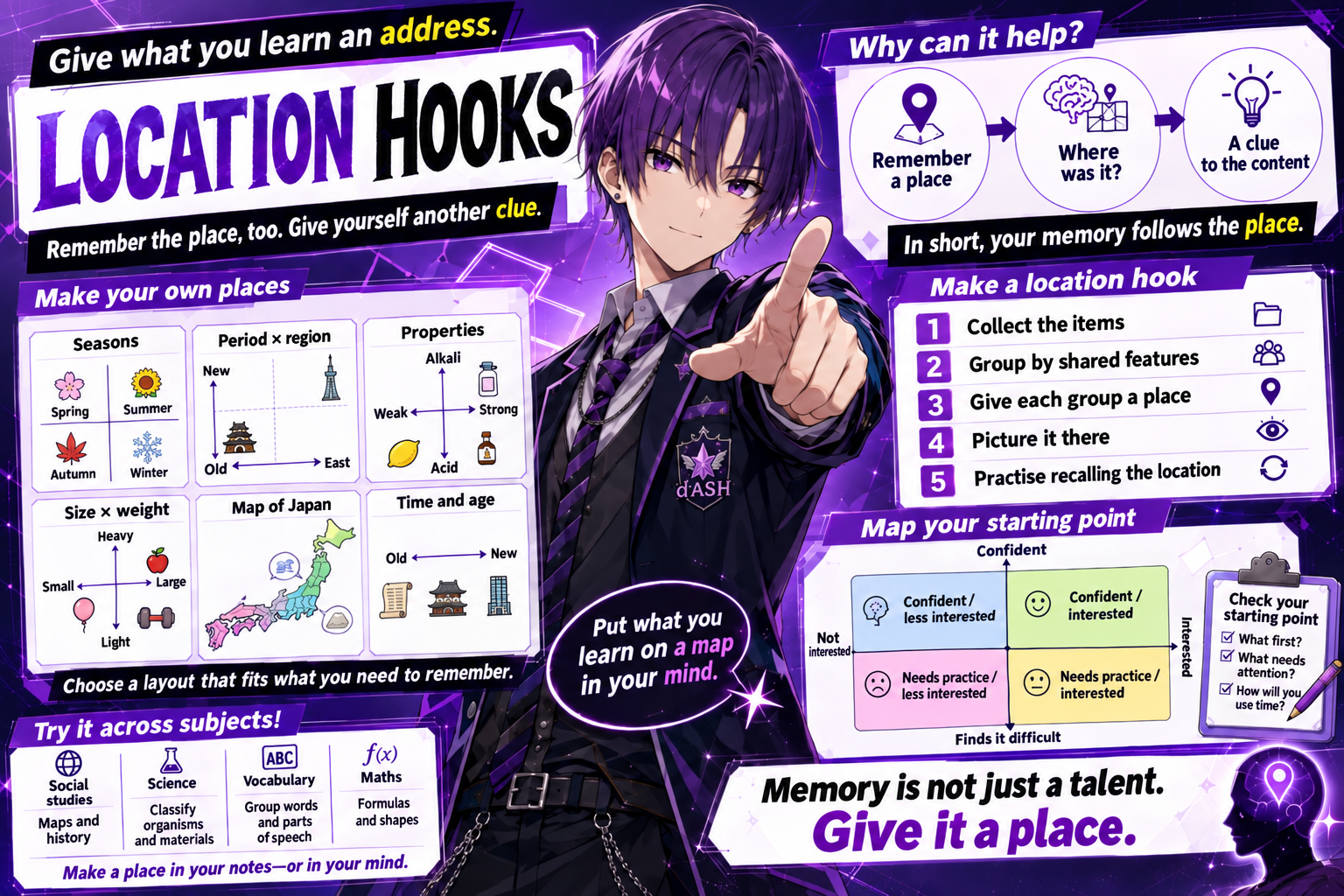
Make your own places
You do not have to use an existing map or table.
Take what you need to learn and
divide it into places of your own.
Once you have found groups using common-feature hooks,
imagine giving each group a place.
EXAMPLE
For spring, summer, autumn and winter,
divide a sheet into four areas,
then put items connected with each season in its area.
“I put that in the spring section.”
Remembering the position
gives you another hook for recall.
Why can it help?
If you learn only the words,
words may be the only clues you have when recalling them.
Add a location, and
you can ask not only “What was it?” but also
“Where was it?”
That gives you another clue.
Even when the content does not come to mind immediately,
remembering its location
may help you find your way back to it.
Give each item an “address”.
That is the idea behind a location hook.
Combine it with common-feature hooks
Location hooks work well with the common-feature hooks introduced earlier.
First, find a shared feature and make a group.
Next, give each group its own place.
Now you have two clues to help you remember:
EXAMPLE
the group and its location
You do the sorting and choose the layout yourself.
That process is part of the practice, too.
Try putting yourself on a map
You can use a simple two-axis map for more than memorising.
EXAMPLE
Confident ↔ finding it difficult
Interested ↔ not interested
Try placing your subjects or units along these two axes.
“I like it, but I find it difficult.”
“I’m good at it, but not very interested.”
You can start to see where you are now.
Where will you start?
What needs more attention?
If you are unsure, put it somewhere you can see it.
Seeing your starting point can make the next step easier to choose.
Memory is not just a talent
As you practise using location hooks,
“Where shall I put this?”
becomes a useful question.
Instead of only trying to memorise, you organise, place, and recall.
You can improve this skill with practice.
Learning to design your own way of remembering is a form of growth, too.
That is how d’ASH sees growth.