
Your marked test is back.
You see the score and feel pleased—or disappointed.
Then do you put the paper away and leave it there?
This test contains clues about what to change next.
Find why some things did not work and what you can now do, then adjust your next study plan.
Reviewing is not a time to blame yourself.
It is a time to choose your next strategy.
01
First, gather your records.
Bring your marked answers, the questions, the answer key, and the workbooks or planner you used.
Start with the records you actually have.
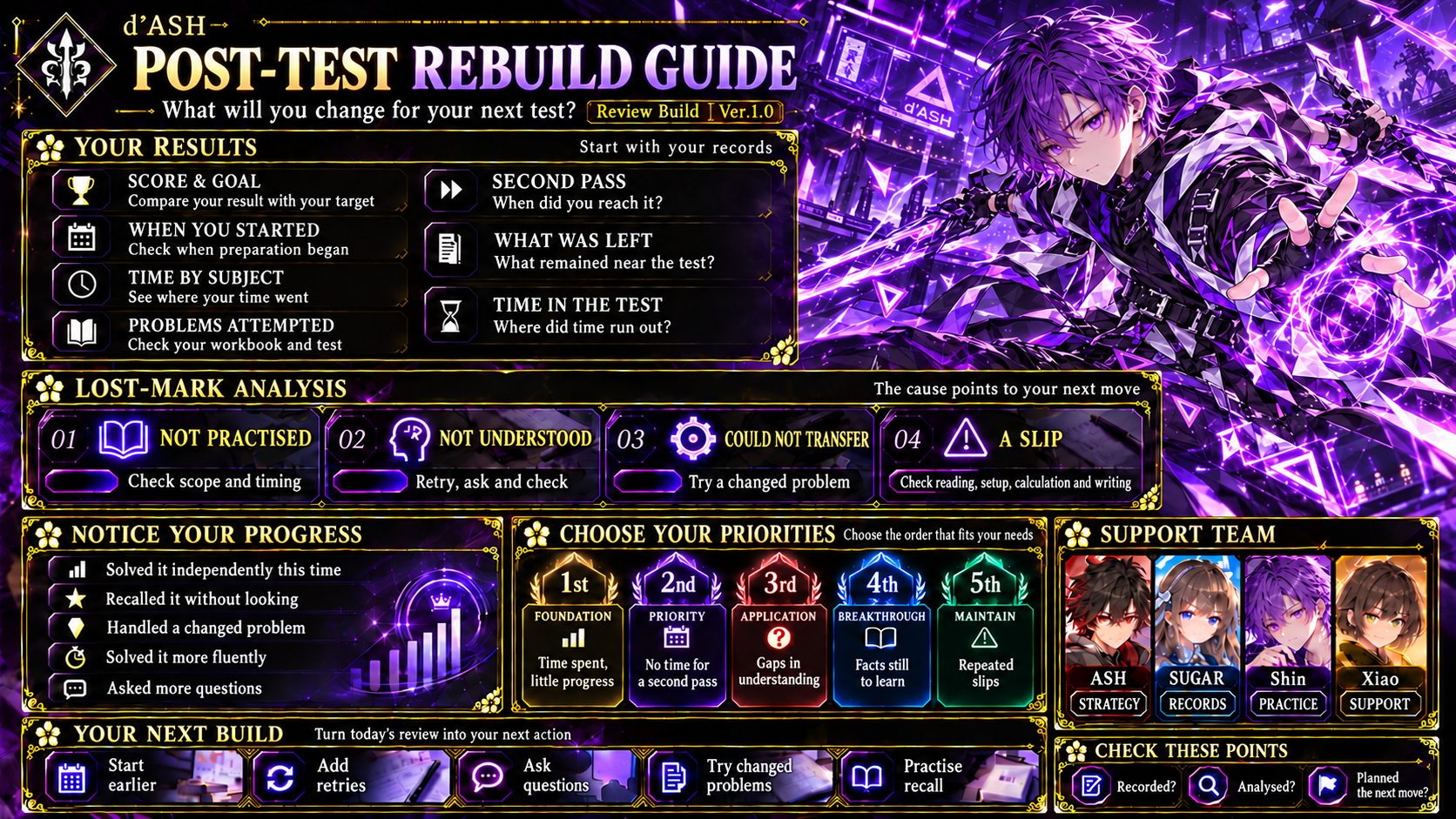
- Score and goal: Your result in each subject and how it compares with your target.
- When you started: When you began preparing for the test.
- Time by subject: Which subjects received time, and which were put off.
- Retries: How often you tried again independently with the answers covered.
- What was left near the test: Topics you had not started, facts you had not learned, and questions you had not asked.
If you do not remember an exact time or count, do not invent a number.
Use your planner and workbook to record what you can check.
Keep copying the answer separate from solving it again independently.
02
Turn lost marks into a next step.
Retry the problems you got wrong or left blank, without looking at the answers.
Then compare with the explanation and open the description closest to your situation.
I had not practised this
Check whether you had practised that content before the test.
Was it missing from your topic list, or left unfinished because time ran out?
Next time, improve your scope check, start earlier, or change how you divide your time.
I still do not understand the explanation
Retry the test question and trace the question and explanation.
Mark what you understand and where you stop.
Ask about that point.
After the explanation, hide the answer and try it yourself.
I practised, but could not solve a changed problem
Look at what changed from the practice problem.
Compare diagrams, conditions and the way the question is asked, not only the numbers.
Try a slightly different problem and check which conditions help you choose the method.
I knew the method, but made a slip
Keep the question, working and answer.
Check for a missed instruction, sign, calculation, unit, or copying error.
Choose a specific point to check next time, then retry the problem.
If you could not recall a term or formula, check whether you had practised recalling it, or only recognised it when looking at it.
Several causes may overlap in one problem.
The label matters less than finding what to check next.
Check correct answers you guessed or cannot explain, too.
Your equations may look different from the explanation and still be a valid method.
If you cannot tell, show your answer and the explanation to your teacher.
03
“I ran out of time”—which kind?
Not enough time to prepare
Check what was still unfinished near the test.
Did you start late, spend too much time on one subject, or stay stuck on one problem for a long time?
Compare what was left with how you studied.
Not enough time during the test
Use your test paper to check where you spent a long time and what you did not reach.
Try a response that fits the cause: change the order, skip and return, or practise with a timer.
Speed alone is not always the answer.
If you stopped because you did not know the method, check your understanding, too.
04
Keep what worked, too.
Not every improvement shows up in the score.
Compare your test and practice problems to find what you can do better than before.
- I solved a problem independently that I could not solve before.
- I recalled a term or formula without looking.
- I chose a method for a slightly different problem.
- Checking my working or the conditions helped me avoid a mistake.
- I asked about a question before the test rather than leaving it unresolved.
When you find an improvement, ask what helped.
Perhaps you retried it on another day, said it aloud, or solved it independently after asking.Keep the approaches that worked for you.
05
Choose a specific change for next time.
Rather than simply adding equal amounts to all five subjects, use your records and answers to choose where to make a change first.
- A subject where time did not lead to results: Check your understanding and practice method before only adding more time.
- A subject with untouched pages near the test: Choose which pages to start first, and when.
- Content you could not recall: Schedule practice recalling it with the answer hidden, on more than one day.
- Problems with repeated slips: Choose what to check and try that check when retrying the problem.
The order in the image is a prompt for thinking about priorities.
You do not have to keep the subjects in a fixed order.
Consider your current understanding and what comes next in class, too.
Turn “I’ll try harder” into a plan
- What will you change? Use your test to choose one thing to change first.
- What will you do? Choose the material, pages and way you will check your learning.
- When will you check? Schedule a starting day and another day to try it again.
If you could solve it just after reading the explanation but got stuck in the test, schedule an independent retry on another day.
If a question went unasked, mark the material and find a chance to ask your teacher.
06
Before putting the test away, check your strategy.
Use these checks while this page is open.
Your marked test is material for your next strategy.
Check what you do not understand now.
Use the clues you found when you start preparing for the next test.
Want to turn your review into a record of your next steps?
Try the Rebuild Sheet to organise your records and priorities, and the Two-week Test Planner to record your next study sessions.