
Memory 7 Contrast Hooks
Focus on what is different
Put similar items side by side, and
compare what is the same and what is different.
Instead of learning each item separately,
identify the shared pattern first,
then focus on the differences.
EXAMPLE
Low and high pressure (Northern Hemisphere)
→ Low pressure → anticlockwise circulation; rising air
→ High pressure → clockwise circulation; sinking air
Using a shared pattern as your starting point helps you organise the differences.
Look for differences as well as similarities.
That can give your memory a useful hook.
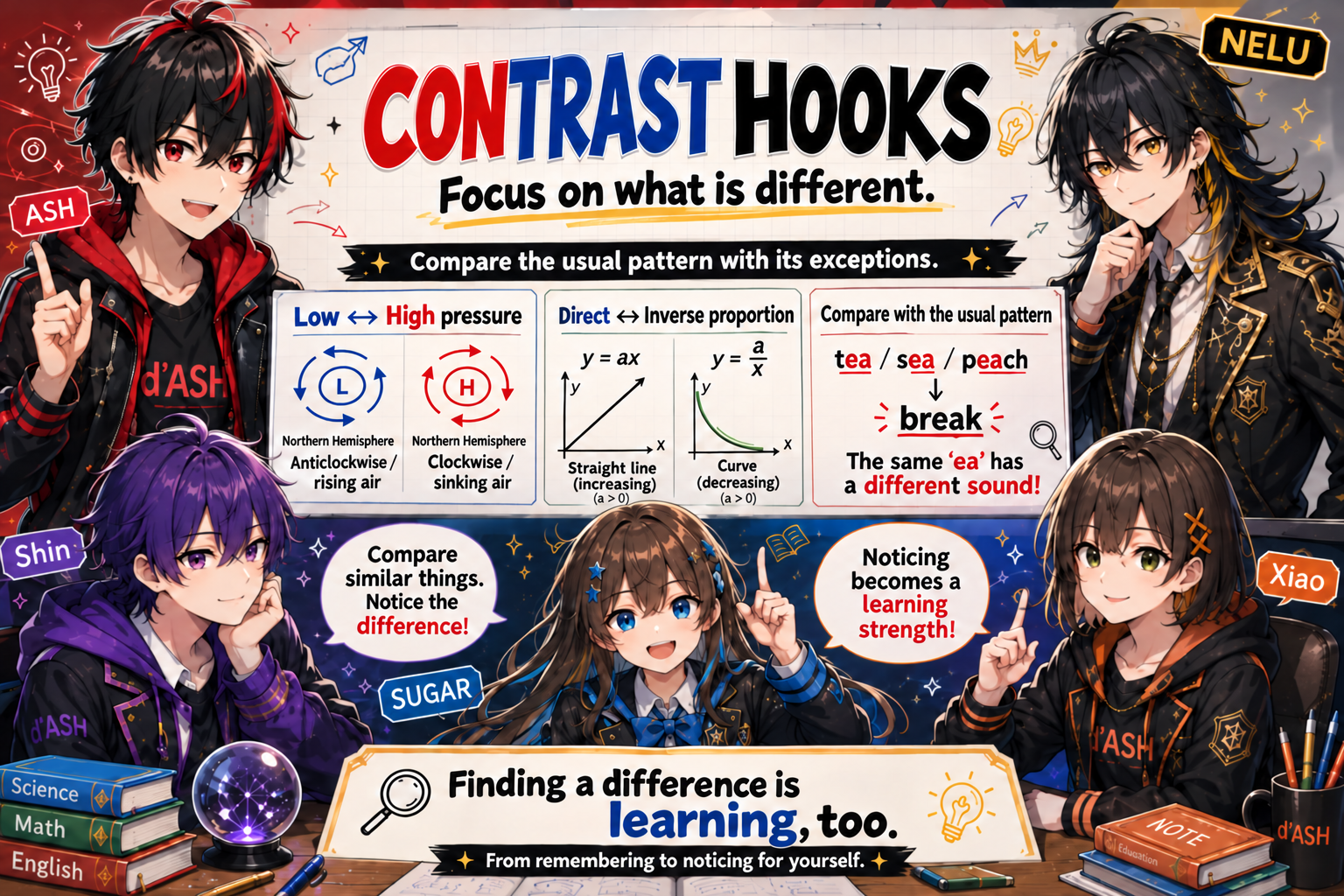
Compare it with the usual pattern
You do not have to compare only two words.
Comparing the usual pattern with an exception is a contrast hook, too.
First, learn the usual pattern.
Then notice the part that breaks it.
The difference can become easier to remember.
“It usually works like this, but this one is different.”
That contrast becomes your hook.
When learning a spelling or pronunciation, do not treat every word as an isolated fact.
Compare it with the familiar pattern and focus on the difference.
That gives you more clues to recall it, and can help the information stick.
EXAMPLE
tea、sea、peach
→ ea is pronounced “ee”
break
→ the same spelling, ea but pronounced “ay”
EXAMPLE
sign → g is silent
signal → g is pronounced
Why can it help?
If you try to memorise everything in the same way,
it can be hard to see what matters.
Comparing makes the differences stand out.
Rather than learning every detail separately,
focus on “this part is different”.
Then you can narrow down
what to pay attention to.
Looking at the exceptions can also make the usual pattern clearer.
Knowing the usual pattern helps you spot a difference.
Noticing a difference helps you understand the pattern.
Comparison can deepen your understanding of both.
One step beyond common-feature hooks
Contrast hooks and common-feature hooks work well together.
First, find what is the same and make a group.
Then go one step further:
“What is different within this group?”
Finding similarities and finding differences:
with both skills,
you are doing more than memorising.
You are learning to organise information for yourself.
Noticing differences is learning, too
This method is not only about
whether you can remember the answers.
“These look similar, but this part is different.”
“This does not follow the usual pattern.”
Learning to notice these things
for yourself matters, too.
As you keep comparing,
you build a habit of looking for differences.
That can help you distinguish similar words or terms,
or spot a small change in a question.
Being able to notice a difference
is a strength in its own right.
Memory is not just a talent
It is fine if the difference is not obvious at first.
Put the items together.
Compare them.
Ask, “What is different?”
Keep doing that,
and you can get better at noticing.
As well as remembering,
you can practise spotting differences for yourself.
A technique you first tried for memorising
can become part of how you think for yourself.
That is how d’ASH sees growth.