
Rather than erasing mistakes,
keep them where you can see them.
What do you do when you get something wrong in a test or workbook?
Erase it, or write the correct answer in red, and move on.
That is probably the most common response.
But if you do that…
Later, you cannot see where things went wrong.
Make your mistakes visible
Try this:
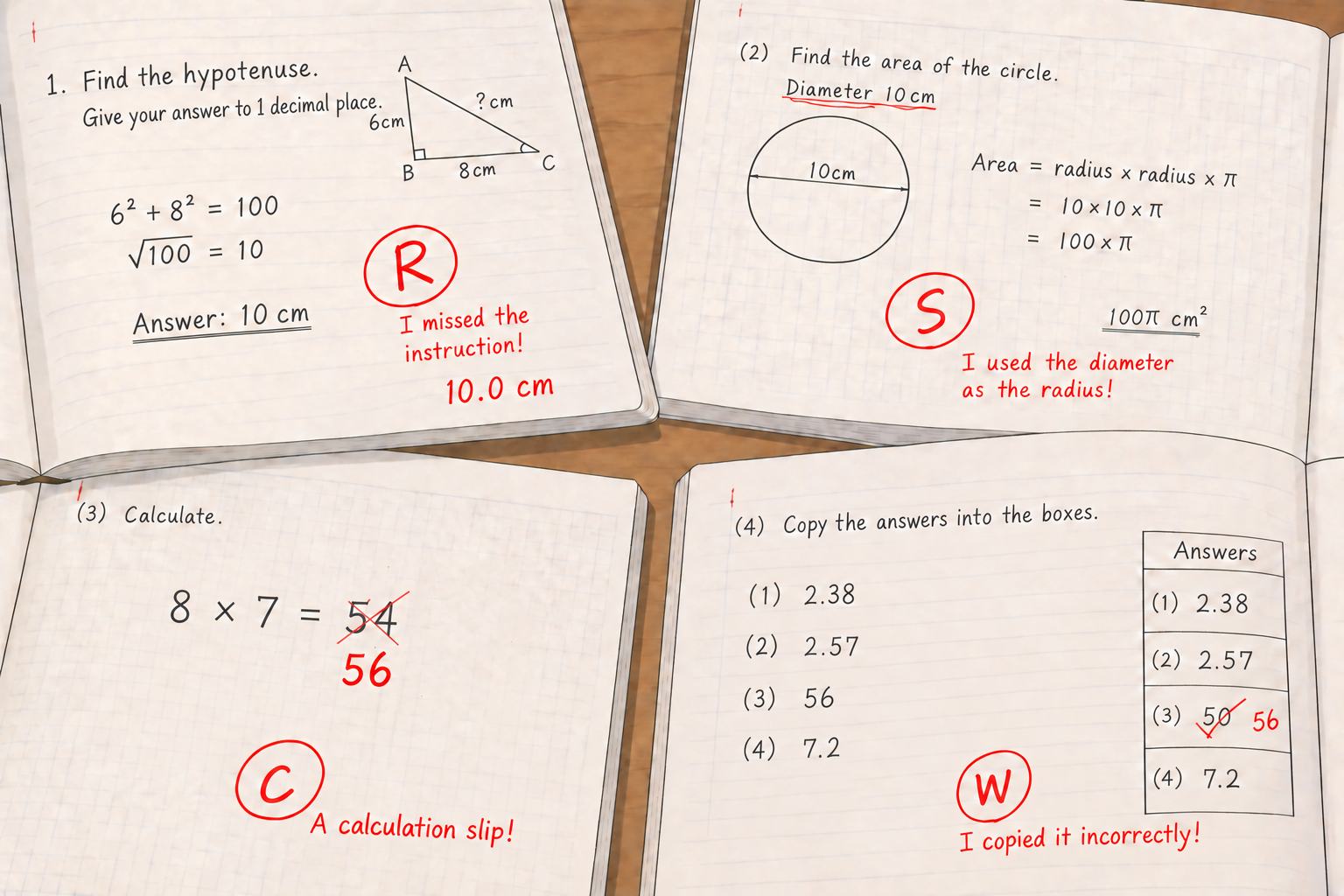
mark each mistake with a symbol that tells you its type.
For example
- Reading error → circled R
- Setup error → circled S
- Calculation error → circled C
- Writing error → circled W
Keep it simple
① Mark a reading mistake with a circled R
② Leave the mistake visible
③ Next time, you can see where you went wrong
What changes when you can see them?
First, you start to notice patterns in your mistakes.
- You keep missing a condition at the end
- You forget to include a unit
- You make a borrowing error
→ You may realise you understand the method, but
keep making the same slip.
And there is another benefit.
You pay attention differently next time.
“Oh, this is where I marked a reading error.”
→ Read a little more carefully
→ Avoid that mistake
As this adds up,
getting it right becomes more consistent, rather than a matter of luck.
Sometimes a mistake is simply a habit.
So, making it visible helps you notice it and reduce it.
Keep it instead of erasing it.
Add a circled R, rather than just a cross.
That small change can make the next attempt different.
The answer gets a cross, but your mistake also gets a circle.
A pretty useful habit, don’t you think?
Three steps to fewer mistakes
- ① UnderstandLearning from Mistakes 1
- ② Keep a recordLearning from Mistakes 2
- ③ Try a strategyLearning from Mistakes 3