Reduce mistakes:
four types to look for
Mistakes happen for a reason.
Let’s start with some common examples.
Start with a mistake you recognise
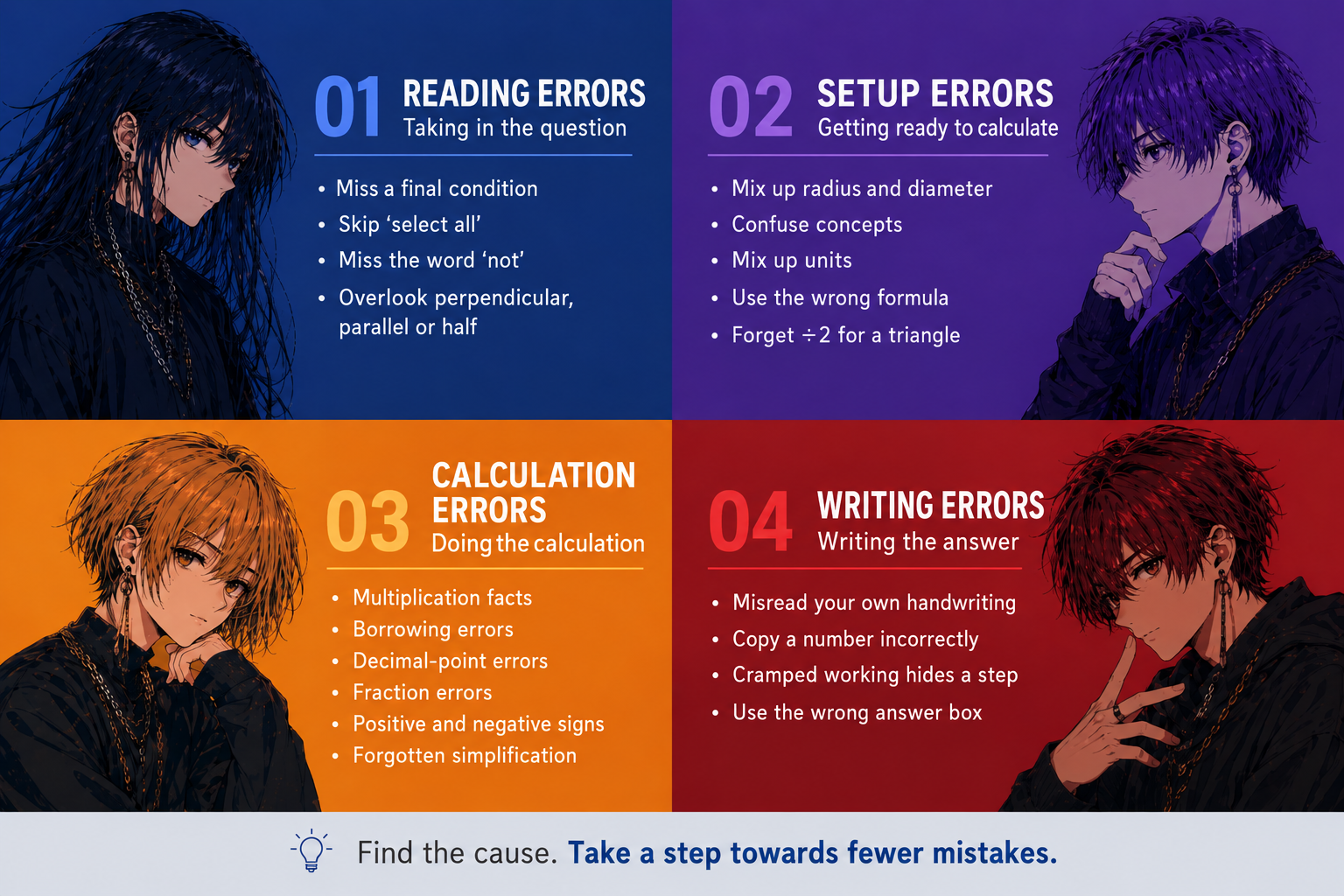
01
Reading errors
Taking in the question
You have not taken in the question accurately.
EXAMPLES
- Conditions at the end
You miss a condition such as “provided that…” at the end of the question. - Skipping instructions
You skip instructions such as “select all” or “give an integer”. - Missing a negative
You read “which is NOT…” as “which is…”. - Numbers hidden in words
You overlook clues such as “perpendicular” (=90°), “parallel” or “half”.
02
Setup errors
Getting ready to calculate
You know the method, but something goes wrong when setting up the calculation.
EXAMPLES
- Setting up the wrong equation
You have all the numerical “ingredients”, but combine them in the wrong equation. - Mixing up concepts
You confuse a value or concept, such as diameter and radius, or parallel and perpendicular. - Converting units
You mix up units, such as distance per hour and distance per minute. - Using a formula
You forget a formula or use the wrong one.
For example, you forget to divide by 2 when finding the area of a triangle.
03
Calculation errors
Doing the calculation
Something goes wrong in the calculation itself.
EXAMPLES
- Arithmetic slips
You mix up a multiplication fact, make a borrowing error, put a decimal point in the wrong place, or miscalculate a fraction. - Missing a calculation rule
You mix up positive and negative signs (+ and −), or forget to simplify a fraction.
04
Writing errors
Writing down your answer
The way you write or organise your work leads to an error.
EXAMPLES
- Unclear handwriting
You misread your own 0 as 6, or 1 as 7. - Copying errors
A number changes when you copy it from your working to the answer box. - Cramped working
Your working is so crowded that you overlook a number in an intermediate step. - The wrong answer box
You write an answer one row away from the correct box.
These four groups give us a way to sort mistakes.
Next, let’s look at what you can do about each type.
Three steps to fewer mistakes
- ① UnderstandLearning from Mistakes 1
- ② Keep a recordLearning from Mistakes 2
- ③ Try a strategyLearning from Mistakes 3