Memory 2 · Colour Hooks
Give differences a colour
When there is a lot to remember, everything can start to look the same.
Try adding a colour.
For example…
EXAMPLE
Japanese prefectures and their capitals
Red → the prefecture and its capital have the same name
White → all other prefectures
Sometimes I learn the red group first.
Then “this one was red” becomes a hook to help me recall it.
Instead of learning every item separately,
first identify what they have in common,
then focus on what is different.
Using the shared pattern as your starting point helps you organise the differences.
Look for differences as well as similarities.
That can give your memory a useful hook.
A colour in your imagination is enough
The colour itself does not need a special meaning.
Maybe red stands out to you, or blue is your favourite.
That is enough.
And rather than using lots of colours, try your normal colour plus just one other.
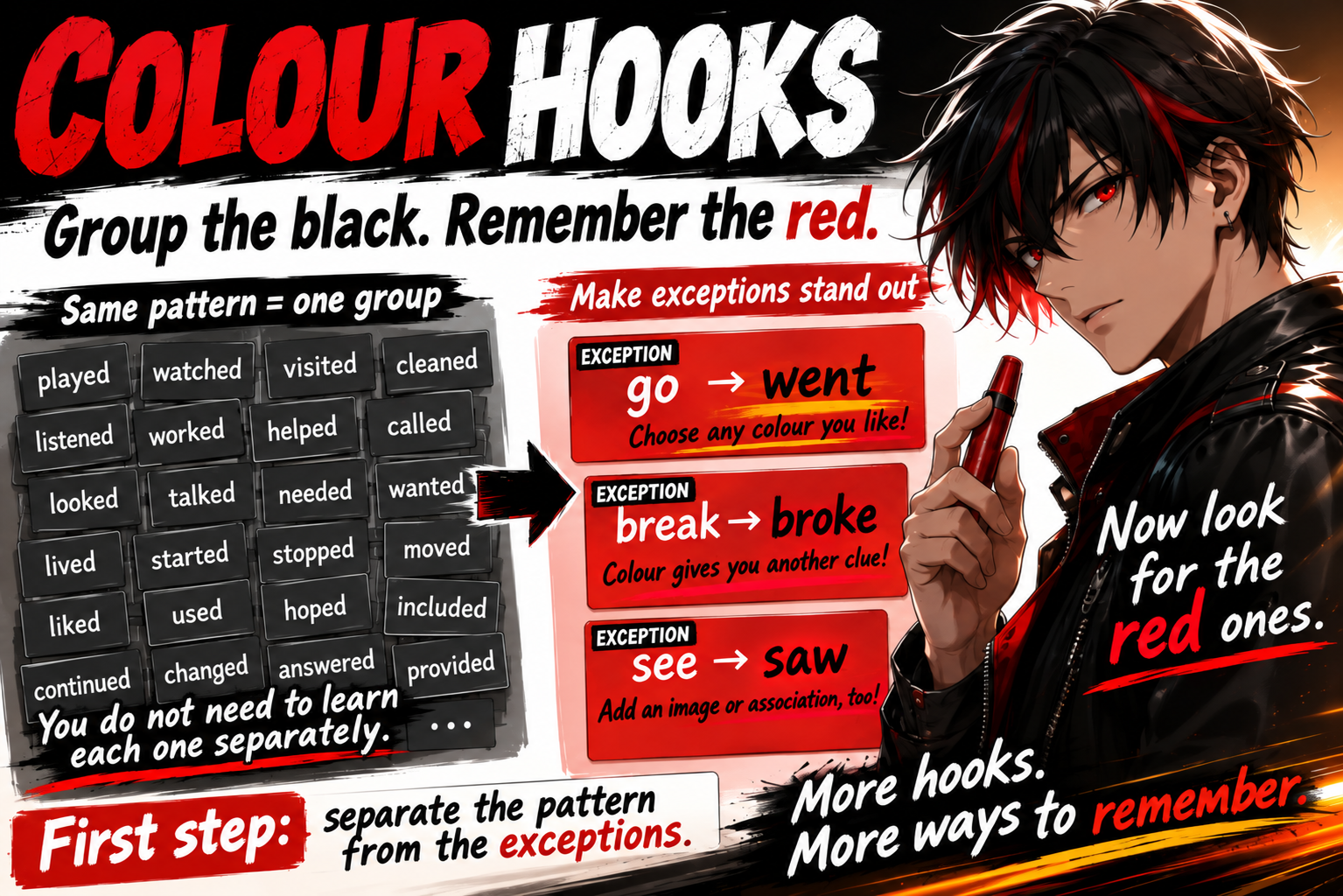
Rather than highlighting everything you need to learn,
make the exceptions stand out.
EXAMPLE
English past-tense forms
Black for regular forms ending in -ed
Red for the irregular forms
Why can it help?
A large amount of information can be hard to remember when it all looks alike.
Group the similar items together and make the exceptions stand out.
The task can feel smaller, and the information can become easier to organise.
What matters is not the colour itself, but
seeing what belongs together and what is different
.
Start with one extra colour and see what stands out.
Noticing differences is learning, too
This method is not only about
whether you can remember the answers.
“These look similar, but this part is different.”
“This does not follow the usual pattern.”
Learning to notice these things
for yourself matters, too.
As you keep comparing,
you build a habit of looking for differences.
That can help you distinguish similar words or terms,
or spot a small change in a question.
Being able to notice a difference
is a strength in its own right.
Memory is not just a talent
Being good at memorising does not always mean learning every item separately.
You can group what is similar and focus on what is different.
One useful skill is finding groups and patterns.
Start with one extra colour, even just in your imagination, to make the differences stand out.
Give it a try.