Memory 4
· Common-feature Hooks
Do not learn everything as separate pieces
A long list can feel like a lot before you even begin.
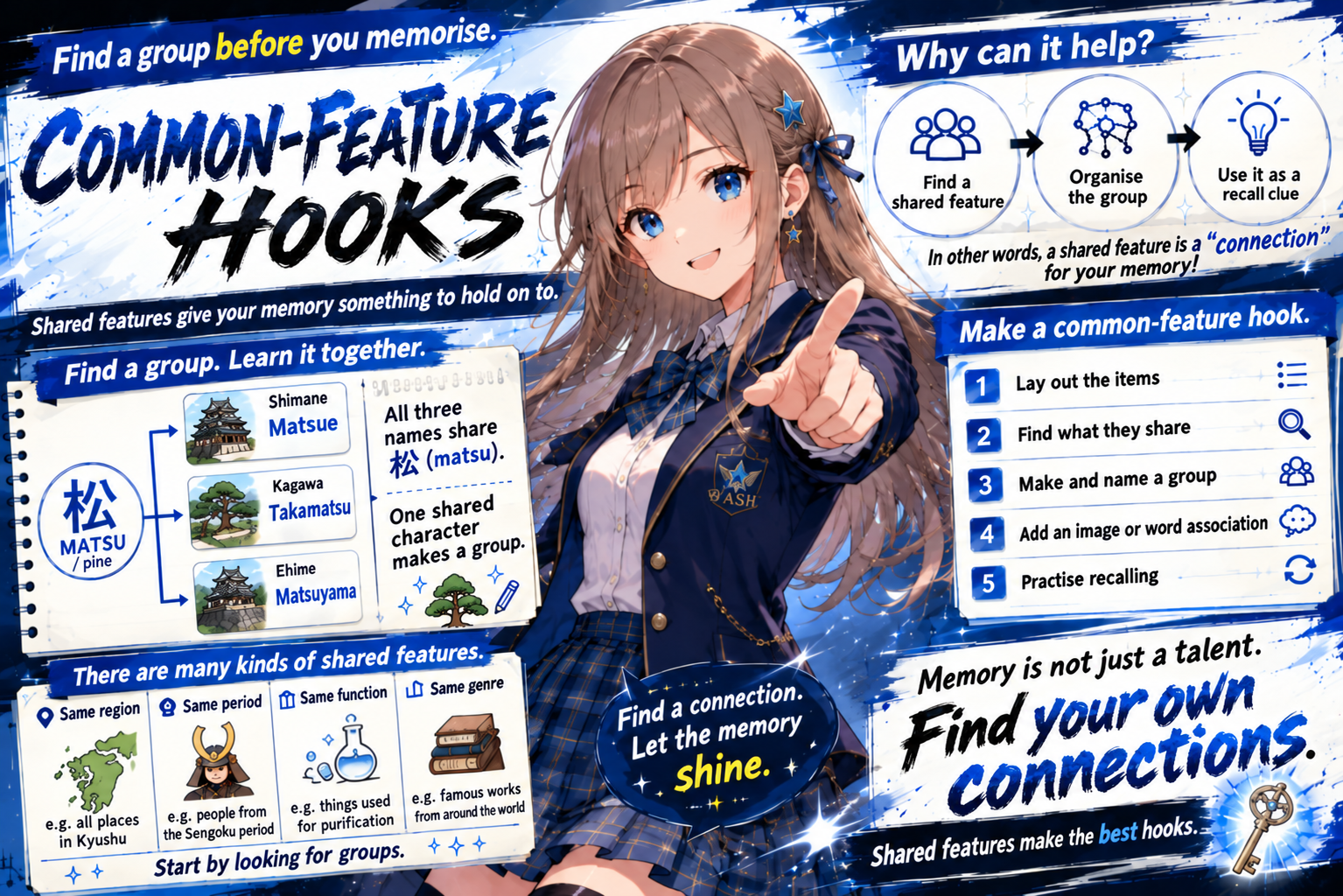
Before learning each item,I look for something they share.
EXAMPLE
Shimane Prefecture → Matsue
Kagawa Prefecture → Takamatsu
Ehime Prefecture → Matsuyama
All three capitals contain the kanji 松, read “matsu” and meaning “pine”.
One shared character turns three separate names into a group.
Find what belongs together
The connection does not have to explain the actual meaning of the names.
Any useful shared feature can work.
EXAMPLE
They contain the same character.
They are in the same region.
They have the same function.
They appear in the same period of history.
Noticing “these belong together” gives you a hook.
Look for a group before learning every item separately.
Why can it help?
Grouping items with a shared feature can make information easier to organise than learning isolated facts.
Instead of treating them as separate items,
think of them as a group and
organise what you need to remember.
Remembering one item can also give you a clue to the others in its group..
The shared feature itself becomes a hook for recall.
Notice the differences, too
Once you have made a group,
take a look at what is different within it.
Because the items belong together,
“this part is different”
can become easier to notice.
First, group by a shared feature.
Then look for differences.
That can help you avoid mixing up similar items.
Try putting yourself on a map
You can use a simple two-axis map for more than memorising.
EXAMPLE
Confident ↔ finding it difficult
Interested ↔ not interested
Try placing your subjects or units along these two axes.
“I like it, but I find it difficult.”
“I’m good at it, but not very interested.”
You can start to see where you are now.
Where will you start?
What needs more attention?
If you are unsure, put it somewhere you can see it.
Seeing your starting point can make the next step easier to choose.
Memory is not just a talent
A long list does not have to stay a long list in your head.
Start by asking,“What do these have in common?” Then look for a connection.
This is a skill you can improve with practice.
You can practise noticing shared features, making groups, and finding hooks for recall.
Getting better at memorising may mean more than remembering a larger amount.
It can also mean getting better at finding a memorable structure.
That is how d’ASH sees growth.