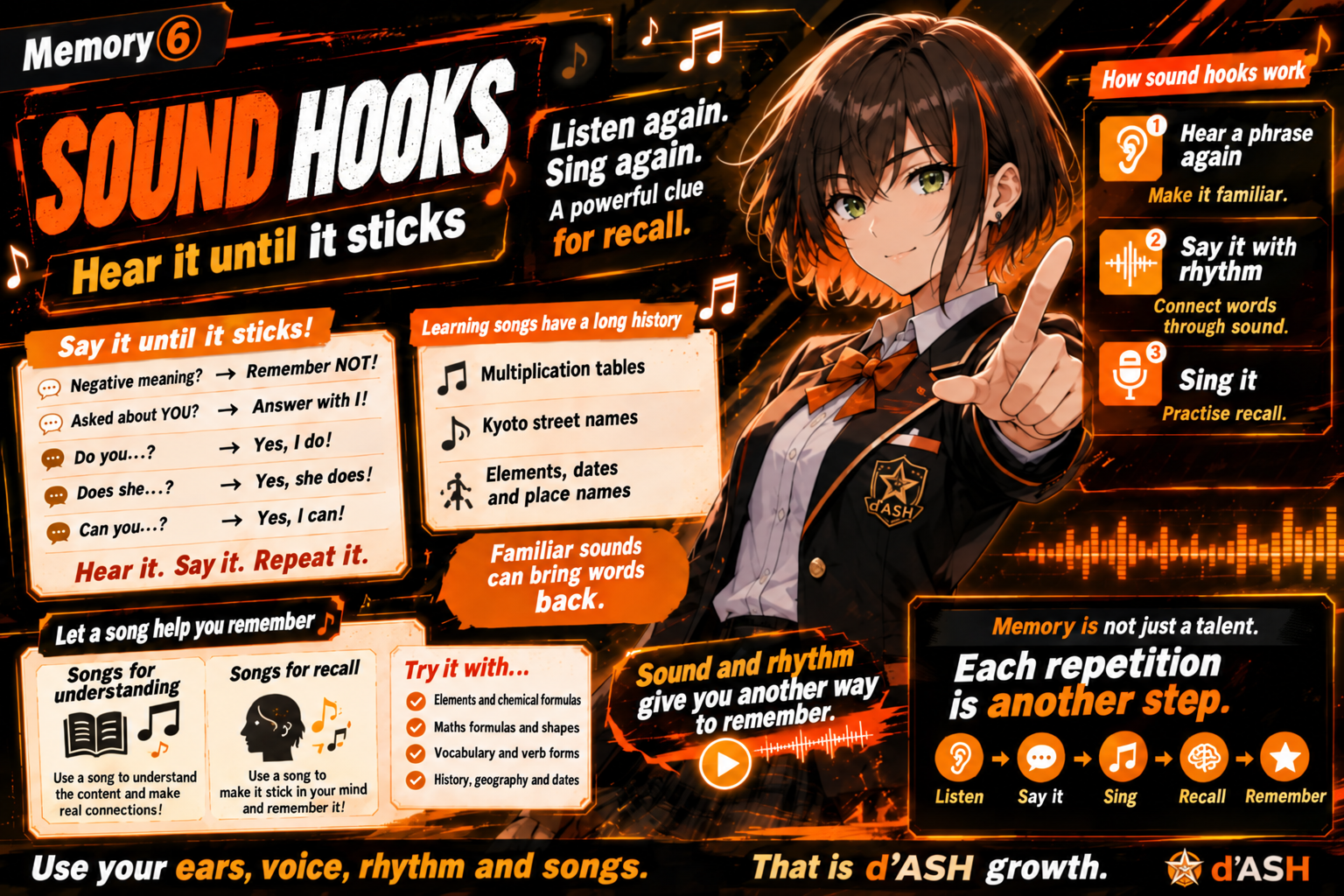
Memory 6 · Sound Hooks
Hear it until it sticks
EXAMPLE
“For a negative, remember NOT!”
“Asked about YOU?
Answer with I!”
“Do you…?
Yes, I do!”
When a teacher repeats something over and over,
“I know already!”
may mean the phrase is starting to stick.
You see a question, and the teacher’s words or voice come back to you.
That is a memory hook, too.
Give your memory a sound hook
If the words on the page will not stick, try saying them aloud.
Make a rhyme or a mnemonic.
Give it a rhythm.
Repeat the same phrase.
EXAMPLE
sign → g is silent
signal → g is pronounced
It does not have to be a brilliant rhyme.
What matters is that
the sound comes to mind when you need it.
Give your ears a hook,
as well as your eyes.
Why can it help?
You listen to a song and wonder,
“What is the next line?”
Then you sing from the beginning, and the line comes back.
Has that happened to you?
A sound or rhythm can help one word lead to the next.
Something you could not recall on its own
may come back when the sound gives you a starting point.
A sound hook uses that idea to help you learn.
With sound or rhythm,
one word can lead you
to the next.
Something you could not recall on its own
may come back when the sound gives you a starting point.
A sound hook uses that idea to help you learn.
Learning songs have a long history
Learning through song is nothing new.
In Japan, people have used songs for multiplication tables and the street names of Kyoto,
among many other things.
You hear them again.
You hum them again.
And over time,
even without trying to memorise every word,
the words may start to come naturally.
Why not use that
in your own learning, too?
Let a song help you remember
Some d’ASH songs
help you explore a subject more deeply.
But that is not all.
Elements, formulas, vocabulary and verb forms—
we also put things you want to remember into songs.
Try those memory songs
as another way into learning.
You do not always have to understand everything before you start remembering it.
You can learn the words in a song first and connect the meaning later.
There can be songs you listen to simply to help the words stick.
Memory is not just a talent
Sound hooks can become more familiar with repetition.
Listen.
Say it aloud.
Listen again.
Then try to recall it.
Words that once took effort may eventually come more readily.
It is not that your memory suddenly changed.
You have practised a way back to the words.
If looking at the page is not enough, you have other options.
Try your ears, your voice, rhythm, and songs.
That is how d’ASH sees growth.