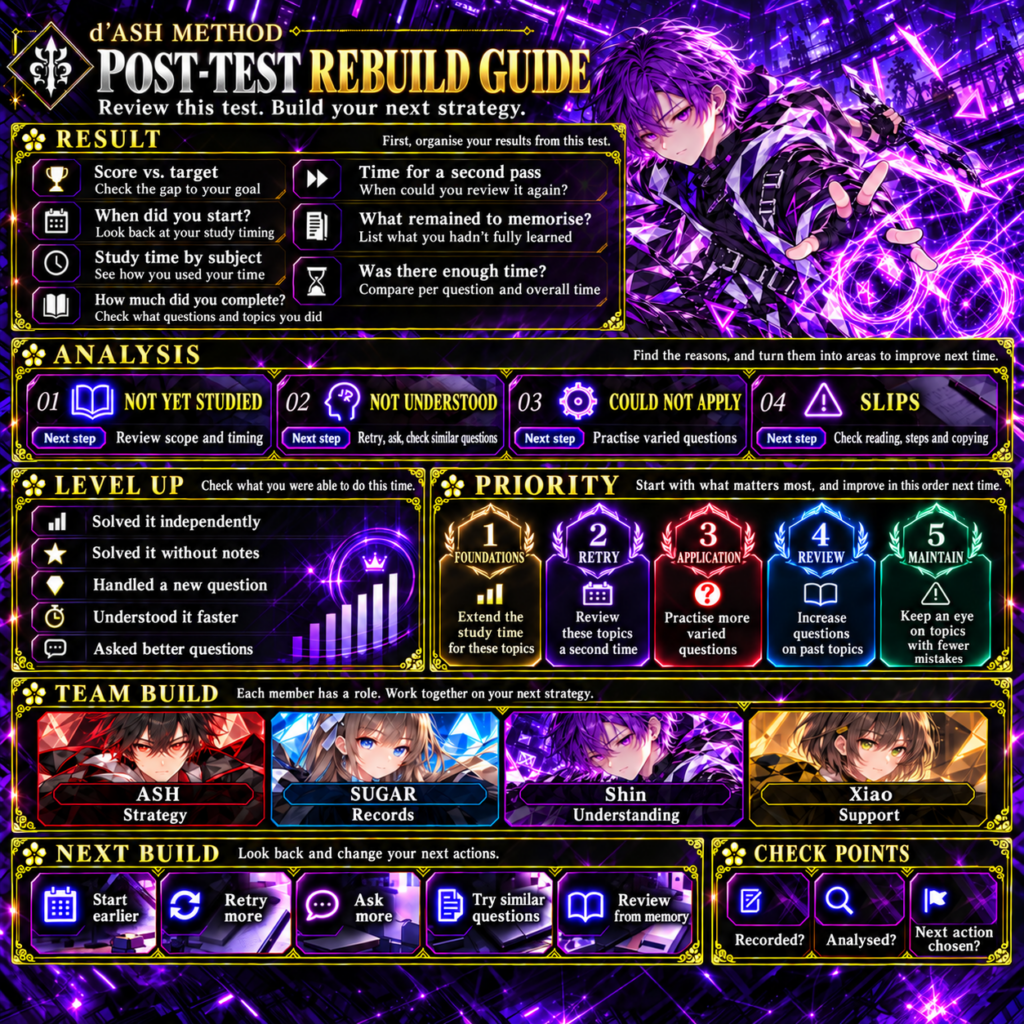
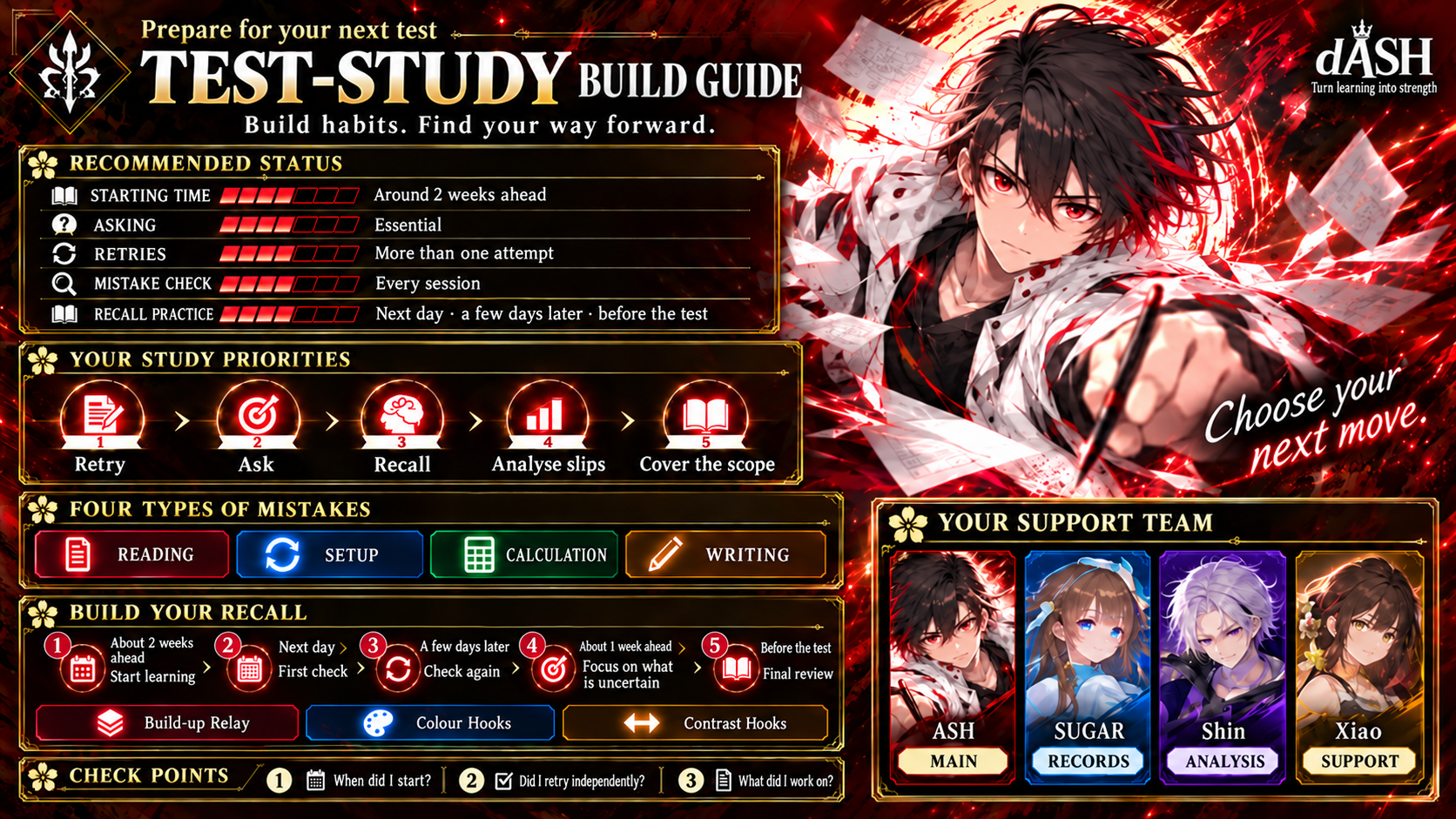
“Start studying two weeks before the test.”
But what should you actually do?
Start the workbook?
Read the textbook?
Make neat notes?
Here are the basics to cover when preparing for a test, in a practical order.
Try the problems, find where you get stuck, ask or practise as needed, then try again on another day.
Start around two weeks ahead so you have time to go through that cycle.
New to this?
Start at 01.
Or jump to the part you need.
01
First, check the scope and assignments.
Check the assignments your school has set.
If the test topics have been announced, keep that list beside you.
- Which textbook and workbook pages are included?
- What must you submit, and when?
- How much have you not started yet?
You can begin even before the test topics are announced.
Start after the units covered in the previous test and work through what you have studied in class so far.
Once the test topics are announced, compare the list with your work.
Check what you need to add or review.
Less than two weeks left?
Start from here.
Check the days remaining, the unfinished assignments and topics, then choose today’s pages.
For maths, try one page of workbook problems on topics you have studied, without looking at the answers.
Check your answers and mark the problems you got wrong or stopped on.
Even if an answer is correct, keep it marked for review if you guessed or cannot explain why it is right.
One page is a way to get started.
Then continue with the parts of the test scope you have not attempted.
Complete your required assignments, and focus your review on the places where you got stuck.
02
Wrong answers do not all need the same response.
A wrong answer does not always mean you did not understand the problem.
You may have skipped a line or chosen the wrong formula.
Perhaps you lost a sign during the calculation.
Or perhaps you read the explanation and still wondered, “Why does that happen?”
Look at the problems you marked in 01 and open the description closest to your situation.
If you do not know the cause yet, choose based on what happens when you read the explanation.
More than one description may apply to the same problem.
I still do not understand the explanation
NEXT MOVE
Put a question mark beside the word or line where you stop understanding
I understand when I read the explanation
NEXT MOVE
Hide the explanation and try the same problem again
I know the method, but made a slip along the way
NEXT MOVE
Keep your working, check for a missed instruction or calculation error, then hide the answer and try again
I could not recall a term or formula
NEXT MOVE
Cover it and try to recall it.
Mark the ones you could not remember.
When you spot a mistake, write a short note about what happened: “I forgot to copy the minus sign” or “I missed the final condition.”
Check that point on your next attempt.
Your working is not necessarily wrong just because it looks different from the explanation. It may be another valid method.
If you cannot tell, ask your teacher.
03
Turn “I don’t understand” into a question.
If the explanation or textbook still leaves you stuck, ask a teacher or tutor.
Note the page and problem number.
Keep your answer and working.
A question mark beside the word or line where you stopped can help you show what you mean.
If you cannot even tell what you do not understand, compare the question, your working and the explanation.
Look for what you can follow and where you stop.
It is okay to say that you do not understand it from the beginning.
If you cannot ask now, note the question and work on another problem you can move forward with.
Choose a chance to ask, such as the next break or after the next lesson.
After asking, check whether you can solve it yourself without looking at the answer.
04
Try it again on another day.
Once an explanation or a question has helped you understand the method, hide the answer and retry the problem.
Solving it immediately does not always mean you will be able to do it tomorrow.
Try the marked problems again on another day, without looking at the answers.
If you get stuck, find the step where it happens.
Return to the explanation or textbook, or ask for help, then try again.
The same goes for facts you have memorised.
Test whether you can recall them with the words covered, rather than say them while looking.
Here is one possible schedule.
The timing is an example: adjust it to your school timetable and what you need to practise.
- Around two weeks before: Check the scope and assignments.
Start with what you have studied and mark the problems that stop you. - From the following day: Retry marked problems and ask about what you do not understand.
Continue with topics you have not attempted. - A few days later: Try the corrected problems and recall the facts again, without looking at the answers.
- As the test approaches: Check for unfinished topics or assignments and focus your review on what still feels uncertain.
Combine moving through new pages with retrying the problems that stopped you.
You do not need to repeat every problem the same number of times.
Give more attention to what you still cannot do independently.
05
Choose a way to remember that works for you.
If a forgotten term or formula stops you in 04, try a different way to learn it.
Add vocabulary a little at a time, use colours, compare similar items, or use your voice and songs as clues.
One method will not suit every subject or term.
“A song helps me remember this.”
“This is clearer in a table.”
After trying a method, cover the terms and recall them, or use them in a problem, to see whether you can really use what you learned.
For a formula, check not only the expression but also when it applies.Can you recall it yourself and use it in a problem? Make that your check.
06
Connect today’s study to your next step
Choose the problems you want to check again and put the next attempt in your planner or calendar.
Keep the page and problem number of anything you want to ask about, too.
Try → find the sticking point → ask or practise → try again on another day.
Do not stop at marking your answers.
Carry this cycle into your next study session.
These are the basics to cover.
Adjust the amount and any extra practice to your school assignments, goals and understanding.
What do you need to check now?
Start by checking the scope and assignments, then try the problems.
Choose a response that fits where you got stuck, and check whether you can now do it.
Use these checks while this page is open.